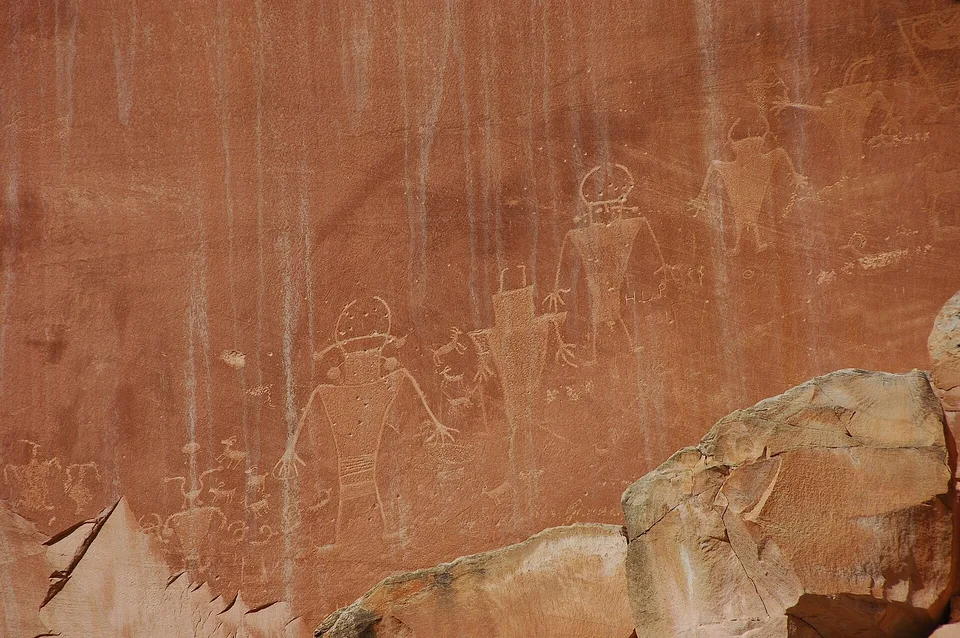
- Oldest art
- About 4,000 to 5,000 years
- Fremont era
- About 400 to 1300 A.D.
- Panels at the preserve
- About 240
- Areas in Utah County
- At least 15
- Nearest village
- Hinckley Mounds, west Provo
Pictures in the rocks
Look west from Vineyard across Utah Lake and you see the Lake Mountains, low and brown on the far shore. On their slopes, and on the knolls and boulders around them, are pictures pecked into the rock by people who lived beside this lake thousands of years ago.
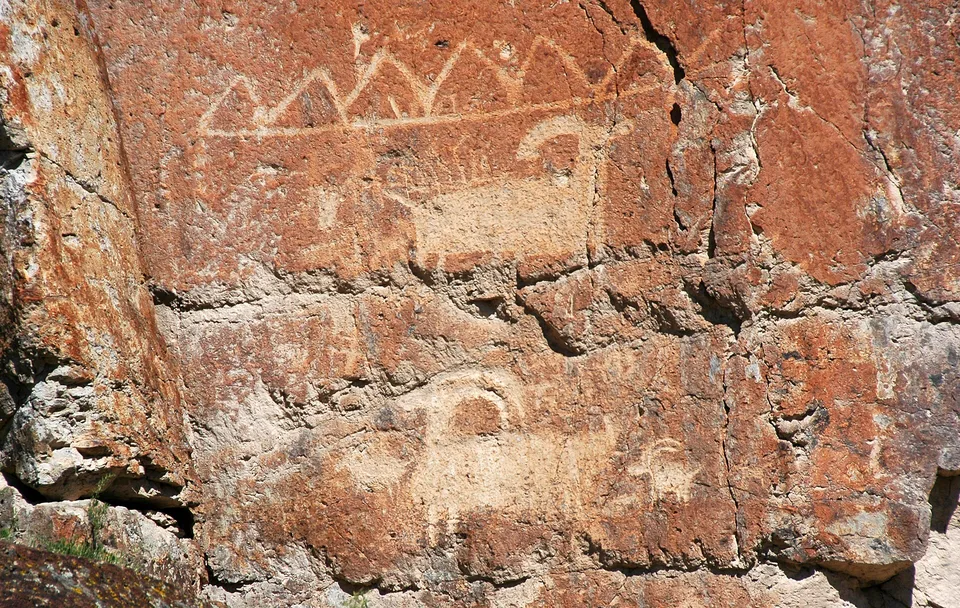
There are snakes and bighorn sheep, people in what look like ceremonial dress, hunters, spirals, circles and wavy lines. One carving looks like a fishing net. Archaeologists call these petroglyphs, pictures pecked or scratched into the dark skin of a rock, as opposed to pictographs, which are painted.
They are not only in one place. Rock art researchers have found petroglyphs in at least fifteen areas of Utah County, including Provo Canyon, Santaquin Canyon, Eagle Mountain, Cedar Fort, West Mountain and the Lake Mountains.
The oldest art in Utah
The richest site is a preserve on the west side of the lake, near the Lake Mountains, kept by the Smith family for about sixty years and given to The Archaeological Conservancy in 2013. On roughly two hundred acres it holds about 240 known rock art panels on well over two hundred boulders. Many boulders have several panels, and many panels have several figures. An archaeologist with the Utah State Historic Preservation Office, Elizabeth Hora, put the total at thousands, and said the count was still not finished.
Some of it is among the oldest rock art in Utah. Researchers who have surveyed the preserve describe a record of carvings spanning thousands of years, from some of the earliest petroglyphs in the state to the arrival of the pioneers. Much of the Lake Mountain art is thought to come from the Archaic period, roughly four to five thousand years ago, made by small bands who moved with the seasons.
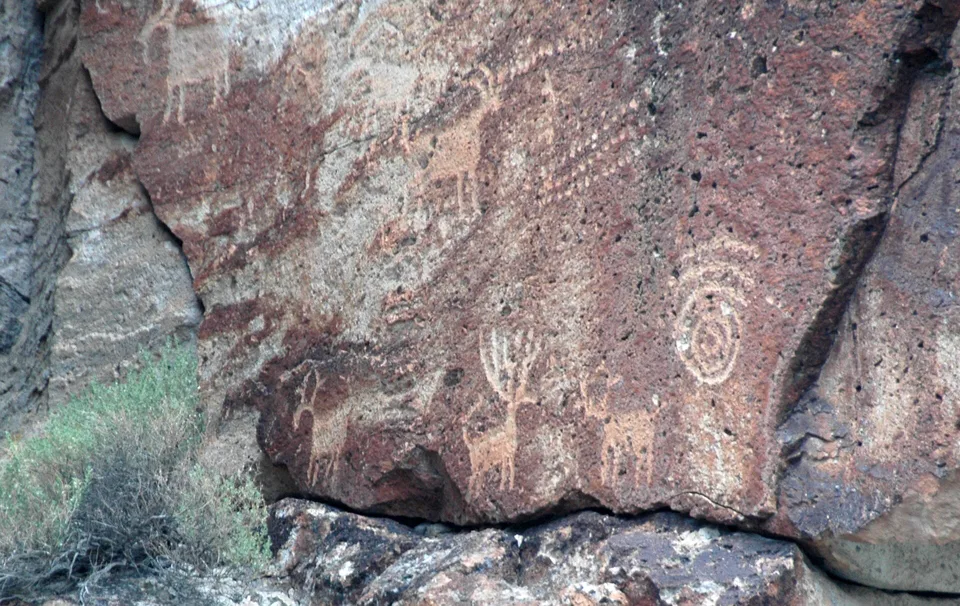
Rock art is hard to date. One clue is the dark mineral coating that slowly grows back over a fresh carving. The older the picture, the more the rock has healed over it. Some of the same symbols carved here turn up across the Great Basin as far as Reno, Nevada, and nobody knows for certain what they meant.
The Fremont
About 1,500 years ago, a new way of life took hold around the lake. Archaeologists call the people who lived it the Fremont, a name borrowed from the Fremont River in southern Utah, where their remains were first described. Nobody knows what they called themselves.
Around Utah Lake the Fremont lived by both farming and hunting. They grew corn, beans and squash, wove baskets to store seeds and nuts, made pottery from the clay of the marshes and built houses with reeds from the shore. Hora called the marshes on the east side of the lake prehistoric grocery stores, full of fish, waterfowl and plants.
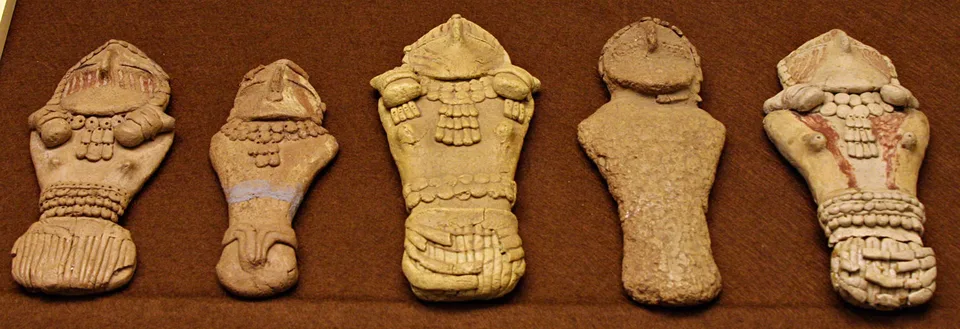
One of their villages still lies in the ground in west Provo, a few miles from Vineyard. The Hinckley Mounds held a large Fremont farming village from about 700 to 1300 A.D. The people built pit houses, half buried homes with wood and brush roofs, on low mounds left by flooding streams. G. Marion Hinckley began letting Brigham Young University classes dig on his family's land in the 1940s, and students are still digging there. Between 1956 and 1960 they found twenty small clay figurines in one of the mounds.
What happened to them
Then, sometime between about 1250 and 1500, the Fremont way of life came to an end. Archaeologists still do not know why. The people may have left, may have changed how they lived during long droughts, or may have joined the new groups moving into the Great Basin, the ancestors of the Utes who met the Spanish friars in 1776.
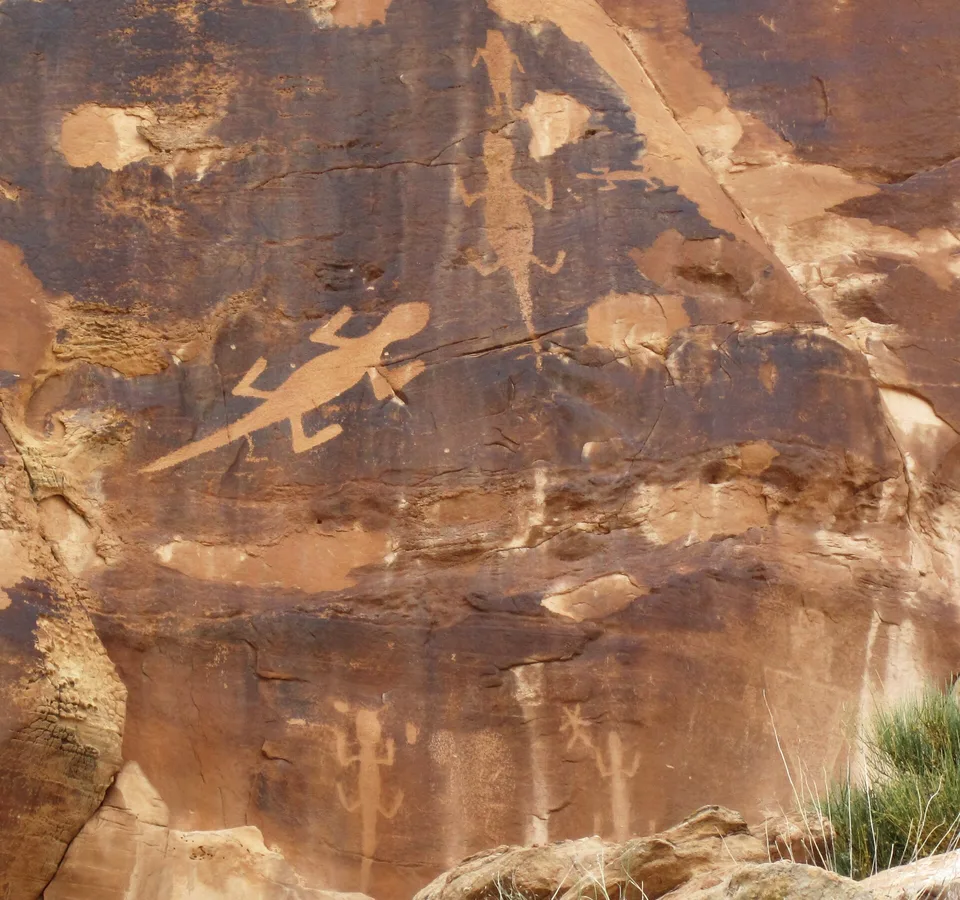
What they left are the pictures. Rock art may have been prayer, magic, a record of a hunt, a marker for a trail or a message to someone who would pass by later. We can see what they carved. We cannot yet read it.
Still disappearing
The pictures are still being lost. Target shooters have broken and scarred panels on the Lake Mountains, and in 2012 a wildfire started by stray rounds burned toward Saratoga Springs. On West Mountain, boulders that researchers had recorded have simply vanished. Volunteers from the Utah Rock Art Research Association have sat on shooting sites to protect the carvings, and students have helped survey the Smith preserve for the National Register of Historic Places.
If you go, look and take pictures, but do not touch. The oils from one hand can damage a carving that has lasted four thousand years.