The first school district in the area, Provo Bench School District No. 18, was organized in 1883 with a budget of eighty dollars. Teachers were paid in potatoes, flour, lumber and other goods. Their examinations were oral and practical, with questions about shoeing horses or planting crops.
The Little Blue Schoolhouse
That same year Niels Larsen built the first Vineyard school, a one room lumber building known as the Little Blue Schoolhouse. In 1890 it was dedicated for church meetings as well. So many children crowded in that the room was partitioned into two, each heated by a coal stove and lit by kerosene lamps. Students sat on plain benches, later double desks. The principal called school to order with a big hand bell, and each teacher kept a long tapered ruler of hickory or oak for discipline.
Each student had a rock slate instead of paper. Books were scarce, so spelling bees and memorizing filled the day. The drinking fountain was a brass bucket filled from a neighbor's well, and fetching the water was a coveted privilege.
Brick and then two stories
In 1894 a red brick, two room schoolhouse replaced the Little Blue Schoolhouse, and another room was soon added to the north end. One teacher had sixty three students her first year and seventy two her second. In 1900 the school joined the new Lincoln School District, and in 1915 the Alpine School District took in all the districts in the north end of the county.
In 1912 Vineyard built a two story, six room school with a furnace, hot water radiators, indoor toilets and a desk for every child. For years only four rooms were finished, each holding two grades that took turns being taught. Children walked a mile or more, through deep snow in winter and mud in spring, sometimes climbing fences and following the railroad tracks to stay out of the worst of it.
A piano and a play
For years the school had no musical instruments. In 1920 a teacher, B. M. Jolley, persuaded the school board to pay half the cost of a piano. Parents raised the rest with a Thanksgiving party: a noon dinner, a dance, and an auction of farm machinery, chickens, pigs and produce, with passing drivers flagged down to bid. At eleven that night a board member stopped the dance to announce that nearly four hundred dollars had been raised. Music teachers followed, and with them cantatas and Christmas programs.
In the early 1920s the school staged a spring play called The Pixies and raised enough money for its first playground: a giant stride, a slippery slide and horizontal bars. Operettas followed, including Snow White in 1924. Vineyard joined Spencer School for May Day, when the children braided a Maypole in the dusty schoolyard, and held track meets against Lake View, Spencer and Lindon.
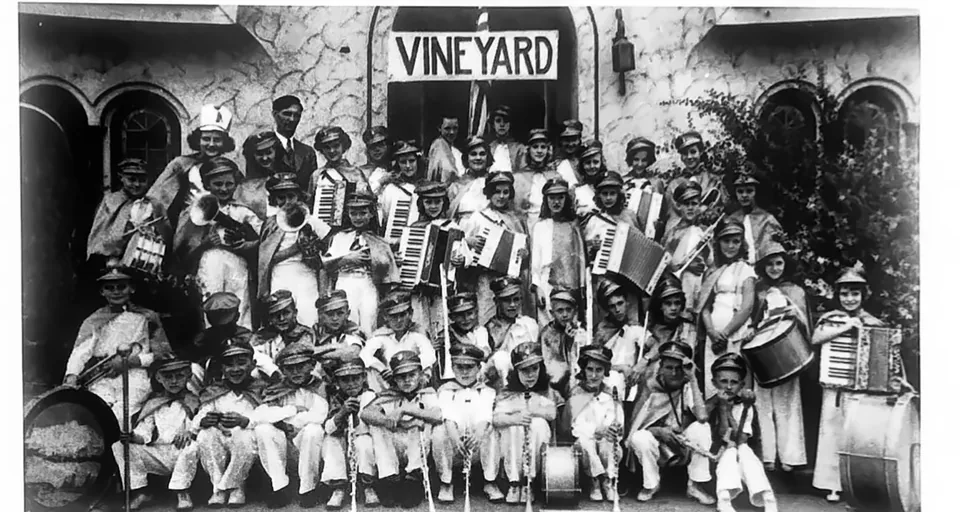
We wore white pants and shirt, a bright blue and gold cape, and hat.Wayne Gammon, trombone
School had its legends. One boy rode his horse up the school steps, through the main hall and out the other side while the principal was across the road at the store. When a friend tried it, the principal caught him and sent him home. For days the boy came to school and stood outside, too ashamed to tell his parents, until the principal finally told him to come in where he might learn something.
The band
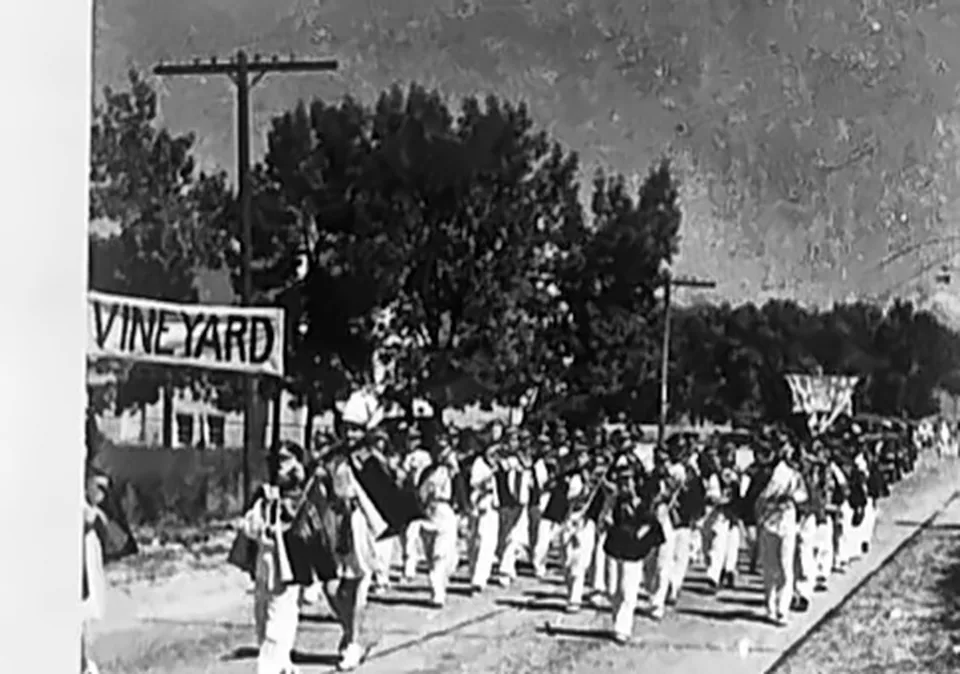
In 1937 Earl A. Beck became principal. He was a trombonist, and he started a band with about thirty five fifth and sixth graders. Parents bought instruments, and soon about thirty musicians were practicing an hour every evening. The band rode an open truck to parades all over Utah County, south to Nephi, and to the Days of '47 parade in Salt Lake City.
They wore white pants and shirts with bright blue and gold capes and hats, and their marching tune, Our Director, came with a dance routine performed on the move. One member later said college bands copied the idea for their halftime shows. Beck led the school for twenty years, until 1957, and taught the children to square dance along the way.
Union School
In 1939, when the Lake View school was torn down, its students joined Vineyard's. Lake View parents did not want their children attending a Vineyard school, and the rivalry ran deep, so the name was changed to Union School. One student remembered that the custodian, tired of the argument, simply announced to the children that it would be Union School from then on.
The school stood beside the steel mill for its last two decades. It closed in 1965, and Vineyard's children went to Alpine District schools in Orem until the town opened a new Vineyard Elementary in 2004.
From vineyardhistory.org/stories/the-vineyard-band/